A friend of mine moved into a flat last year with exactly one window, facing north, half blocked by the building next door. She loves plants. She was convinced her new place had killed that hobby for good. It hadn’t — she just needed to stop thinking about “sunlight” and start thinking about “light,” which turns out to be a much bigger category than most of us assume.
If you’re in a similar spot — a windowless room, a basement, an office cubicle, an apartment where the sun barely visits — this is for you.
“No sunlight” isn’t one single problem
People throw around “low light” and “no light” like they mean the same thing, and they really don’t. A room ten feet from a window, or one that only faces north, still gets usable daylight during the day, just not direct rays. That’s low light. A closet, an interior room, a basement with zero windows — that’s a different situation entirely, and no houseplant on earth photosynthesizes off good intentions. You need an actual substitute there, which usually means a grow light.
It’s worth figuring out honestly which category you’re in before you spend money, because the plants and the setup are pretty different for each.
Plants that don’t ask for much
For the low-light camp — dim rooms, not zero-light ones — a handful of plants are genuinely forgiving.
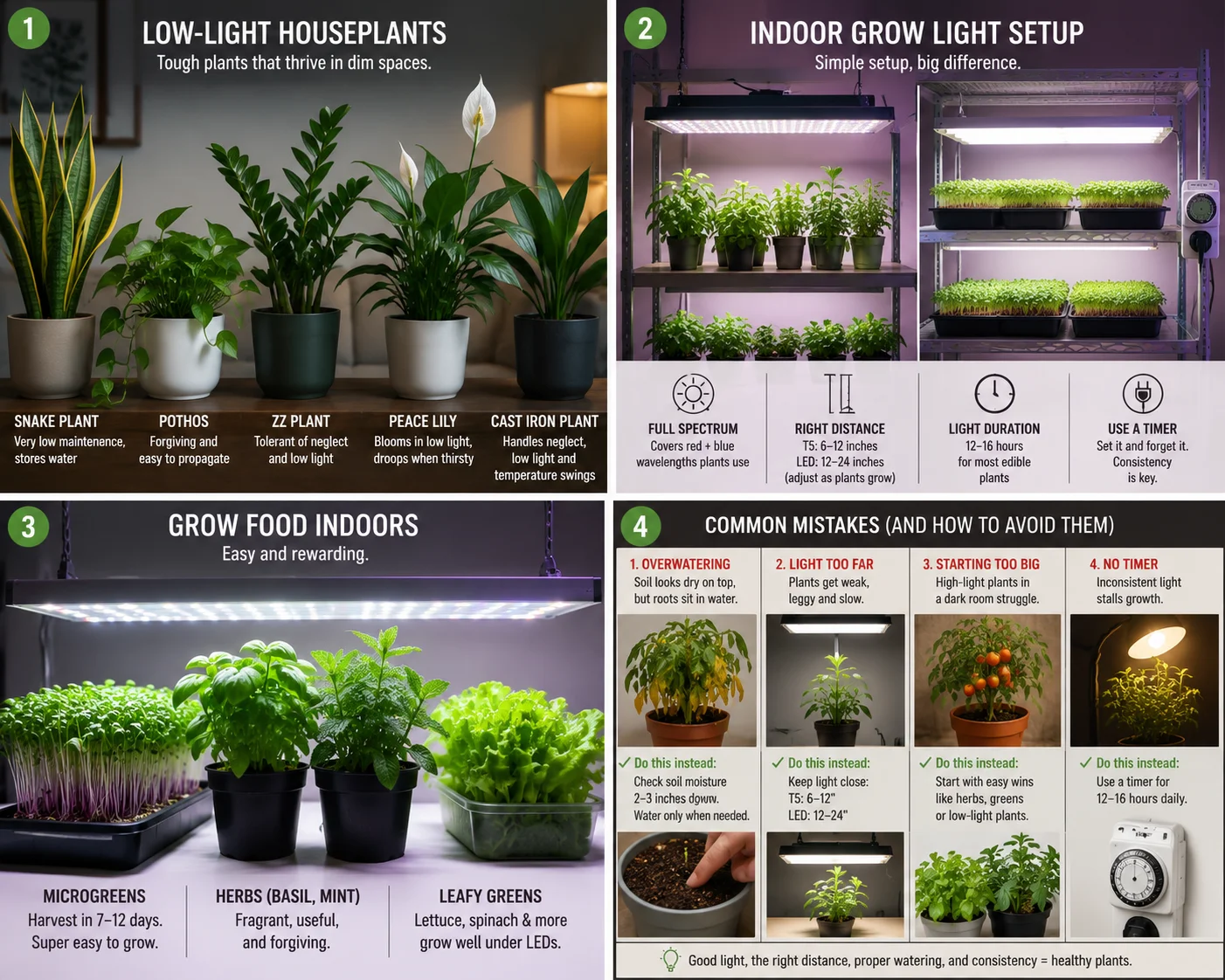
Snake plants are the obvious starting point. Thick, upright leaves that store water, so the plant can go weeks without attention. Honestly, the biggest way people kill these isn’t neglect, it’s the opposite — watering them like a normal plant when they’d rather be left alone for a while.
Pothos is another good one, mostly because it forgives almost everything. Trailing vines, easy to propagate (just snip a piece and drop it in water), and it’ll grow in conditions that would make a fussier plant sulk.
ZZ plants have that same “doesn’t care” attitude — glossy leaves, tolerant of irregular watering, good if you’re the type who forgets a plant exists for two weeks at a stretch.
Peace lilies are a bit different because they’ll actually flower even without much light, which most shade-tolerant plants won’t bother doing. They’re also honest about their needs — they droop when thirsty and bounce back within hours of watering, so you rarely have to guess.
And cast iron plants live up to the name. Neglect, temperature swings, dim corners — none of it bothers them much.
One pattern across all of these: less light means slower growth, which means less water use. Most low-light houseplant deaths trace back to overwatering, not underwatering, because people keep watering on a schedule instead of checking the soil first.
What about actually growing food?
This is where it gets more interesting, and also where you can’t really avoid buying a light.
Tomatoes and peppers need serious light intensity — realistically not happening in a dark room without a proper grow light setup, and even then it’s a bigger commitment. But there’s a decent middle ground that doesn’t ask for much.
Microgreens are probably the easiest entry point I’ve seen. Shallow tray, some seed, a basic light, and you’re harvesting in a week to twelve days. It’s almost embarrassingly simple once you’ve done it once.
Leafy greens — lettuce, spinach, that category — do fine under an ordinary LED or fluorescent setup and don’t need much floor space. Herbs like mint and basil are similarly forgiving and a nice way to have something fresh on hand without committing to a full indoor farm.
Grow lights, without the jargon
This part scares people off more than it should.
LED versus fluorescent is really a cost-and-patience question. LEDs cost more to buy but use roughly half the electricity of fluorescents and last far longer, so over a year or two they usually work out cheaper. Fluorescent T5 fixtures are the cheaper way in — you can find a decent one for somewhere between $30 and $80 — and they’re a fine place to start if you’re not ready to spend more.
The color of the light matters more than people expect. Plants mostly use red and blue wavelengths — blue pushes leafy growth, red pushes flowering and fruiting. Full-spectrum LEDs try to cover both at once, which is really the path of least resistance if you don’t want to think about it too much.
On intensity: shade-tolerant houseplants get by on relatively little — somewhere around 75 to 150 foot-candles. Herbs and leafy greens want more, closer to 250–400. Fruiting plants want 400 or higher. You don’t need to own a light meter to use this — it’s more a sanity check for why your tomato dreams under a cheap desk lamp probably won’t pan out.
Timing matters too. Most food-producing plants want something like 12 to 16 hours of light a day when there’s no natural daylight helping out. Buy a cheap plug-in timer on day one. It sounds like a small thing, but forgetting to switch a light on for two days running is one of the more common ways people accidentally stall their plants.
And distance — this trips up more beginners than anything else. A light across the room barely does anything. T5s usually want to sit 6 to 12 inches above the plant, LED panels a bit further depending on strength, and you’ll need to keep adjusting the height as things grow.
Where beginners usually go wrong
Overwatering shade-tolerant plants because the soil “looks dry” when it isn’t, is probably the single most common mistake. Second most common: putting a grow light too far from the plant and wondering why nothing’s happening. Third: starting with something ambitious — a tomato plant, say — in a completely dark room, instead of easing in with something more forgiving. And fourth, skipping the timer and trying to remember lights-on and lights-off by hand, which works for about four days before it doesn’t.
If you want to just start something this week
Grab a small shelf near an outlet. Pick up either a basic T5 fixture or an affordable full-spectrum LED strip — nothing fancy. Set a timer for around 14 hours. Start a tray of microgreens or a small pot of basil, and put a snake plant or pothos nearby just to prove to yourself that a genuinely dark room can still hold something green and alive.
Give it two or three weeks before judging it. You’ll know fairly quickly whether the setup is working, and from there it’s mostly a matter of scaling — another shelf, a stronger light, a wider mix of plants.
No sunlight really doesn’t have to mean no garden. It just means a different set of tools.