
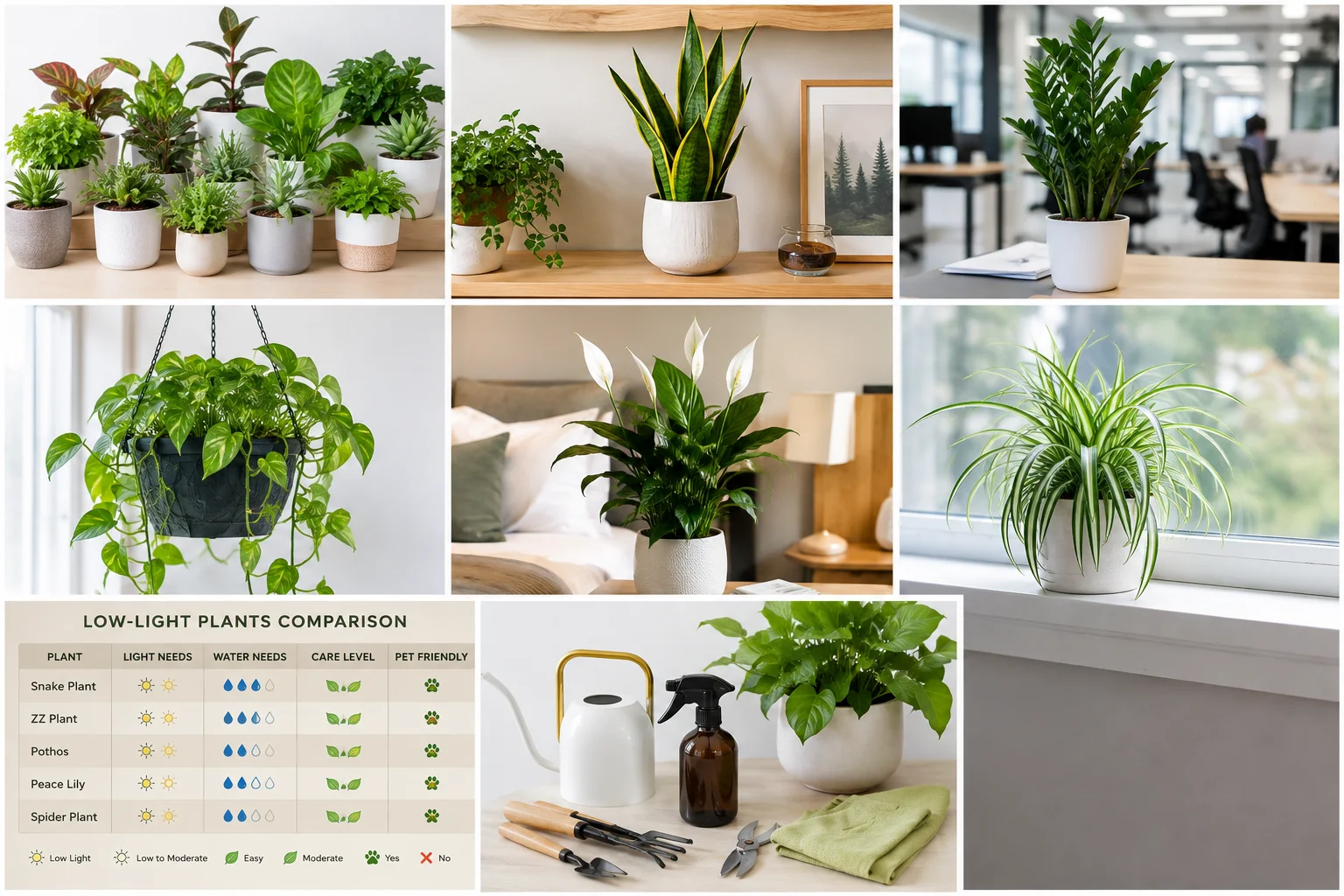
Small Indoor Plants That Don’t Need Sunlight
Bringing greenery into your home doesn’t require a sunny window or a large backyard. Many of the plants on this list evolved on tropical forest floors, growing under the canopy of taller trees — which is exactly why they’re comfortable in a dim apartment corner or a north-facing office cubicle.
No houseplant survives in total darkness forever — every plant still needs some light for photosynthesis. But the 15 below tolerate low light far better than most, and several will visibly sulk if you give them too much direct sun instead.
Why Choose Small Indoor Plants?
- Fit on a desk, shelf, or windowsill without hogging floor space
- Cheaper to buy and easier to repot than large floor plants
- Forgive irregular watering schedules better than most flowering plants
- Easy to rearrange as the light in a room changes with the seasons
- A good low-stakes way to start if you’ve killed plants before
Do Indoor Plants Really Grow Without Sunlight?
Not quite — but this is where most beginners get confused. “Low light” doesn’t mean no light. It means the plant can survive on:
- Indirect daylight a few feet back from a window
- North-facing window light
- Office fluorescent lighting
- LED grow lights running 10–12 hours a day
A room with zero windows and zero artificial light will eventually kill even a snake plant — it’ll just take months instead of weeks, which is part of why people mistakenly believe these plants need “no light at all.”
1. Snake Plant (Dracaena trifasciata, formerly Sansevieria)
The plant people recommend to friends who’ve killed everything else. Its stiff, upright leaves store water, which is exactly why it punishes overwatering more than underwatering.
Light: Tolerates deep shade but grows faster in bright indirect light. Water: Let soil dry out completely — every 3–6 weeks depending on season. Root rot, not neglect, is what actually kills these. Pet safety: Mildly toxic to cats and dogs if chewed (contains saponins); keep away from nibblers.
2. ZZ Plant (Zamioculcas zamiifolia)
Glossy, almost plastic-looking leaves that stay attractive year-round with minimal input. It grows from a potato-like rhizome that stores water, so it’s built for people who forget their plants exist for weeks at a time.
Light: Handles genuinely dim corners, even 6+ feet from a window. Water: Only when soil is bone-dry; overwatering causes yellowing faster than almost any plant on this list. Pet safety: All parts are toxic if ingested — a common pick for pet-free homes specifically because of this.
3. Pothos (Epipremnum aureum)
Often called the easiest houseplant on earth, and the trailing vines look good almost anywhere — bookshelves, hanging baskets, or trained up a moss pole.
Popular varieties: Golden Pothos, Marble Queen, Neon Pothos, Jade Pothos — mostly differing in leaf color, not care needs.
Light: Low to bright indirect; variegated types (Marble Queen) need slightly more light to keep their pattern. Water: Weekly check — water when the top inch of soil is dry. Pet safety: Toxic to cats and dogs (calcium oxalate crystals); a frequent cause of vet visits for curious kittens.
4. Chinese Evergreen (Aglaonema)
Bred in dozens of leaf patterns — some solid green, some splashed pink or silver. Darker-leaved varieties tolerate lower light; the pink and red cultivars need brighter spots to hold their color.
Water: Top inch dry before rewatering. Pet safety: Toxic if ingested; keep off low tables in homes with cats.
5. Lucky Bamboo (Dracaena sanderiana)
Not actually bamboo — it’s a Dracaena that’s often grown in a vase of water and pebbles instead of soil, which is part of its appeal for desks and small spaces.
Water (if grown hydroponically): Change the water every 1–2 weeks and use filtered or distilled water — tap water’s fluoride and chlorine can brown the tips. Pet safety: Toxic to cats and dogs.
6. Spider Plant (Chlorophytum comosum)
Sends out long runners with baby plantlets (“spiderettes”) that you can snip and root in water — an easy, satisfying way to multiply your plant collection for free.
Light: Bright indirect light produces the most plantlets; low light keeps it alive but slows babies. Pet safety: Non-toxic — one of the few plants on this list that’s genuinely safe around cats and dogs.
7. Peace Lily (Spathiphyllum)
The white “flowers” are actually modified leaves called spathes. In low light you’ll get fewer blooms, but the dark green foliage stays lush regardless.
Water: Keep soil lightly moist — this is one of the few plants here that will droop dramatically when thirsty, which is actually useful as a built-in reminder. Pet safety: Toxic to cats and dogs.
8. Heartleaf Philodendron (Philodendron hederaceum)
Similar care to pothos and often confused with it — the easiest tell is the leaf shape (heart-shaped and slightly glossier) and new growth, which emerges wrapped in a papery sheath called a cataphyll.
Pet safety: Toxic to pets, same as pothos.
9. Cast Iron Plant (Aspidistra elatior)
Victorian parlors used this plant specifically because it survived gas lighting, coal dust, and irregular watering — it’s earned its reputation the hard way over more than a century of cultivation.
Water: Very forgiving; allow soil to dry between waterings. Pet safety: Considered non-toxic, a safer pick for multi-pet households.
10. Parlor Palm (Chamaedorea elegans)
A genuinely low-light-tolerant palm — most palms actually need bright light, which makes this one an exception worth knowing.
Water: Keep lightly moist; avoid letting it sit in standing water, which causes root rot quickly in this species. Pet safety: Non-toxic — safe around pets.
11. Prayer Plant (Maranta leuconeura)
Named for its habit of folding its patterned leaves upright at night, as if in prayer, then flattening again by morning.
Water: Prefers consistently moist soil and higher humidity than most on this list — a bathroom with a window often suits it well. Pet safety: Non-toxic.
12. Dracaena Compacta (Dracaena fragrans ‘Compacta’)
A slow-growing, rosette-shaped Dracaena that holds its shape well without pruning, which makes it popular for offices where nobody’s trimming plants weekly.
Pet safety: Toxic to cats and dogs, like most Dracaenas.
13. Nerve Plant (Fittonia albivenis)
Grown for its dramatically veined leaves — white, pink, or red netting across green foliage. It’s also one of the fussier plants here: it wilts fast when dry but usually bounces back within an hour of watering.
Water: Keep evenly moist; this is not a “let it dry out” plant like the snake plant or ZZ plant. Pet safety: Non-toxic.
14. Peperomia (multiple species, e.g. Peperomia obtusifolia)
A large genus of compact, often succulent-leaved plants that rarely outgrow a small pot — good for narrow shelves or crowded windowsills.
Water: Let soil dry between waterings; thick leaves store some water like a succulent. Pet safety: Non-toxic.
15. Bird’s Nest Fern (Asplenium nidus)
Unlike finicky ferns like maidenhair, this one tolerates average indoor humidity reasonably well, though it still prefers more moisture than a snake plant or ZZ plant.
Water: Keep soil lightly moist; mist occasionally if your home is very dry. Pet safety: Non-toxic.
Quick Comparison Table
| Plant | Water Frequency | Pet-Safe? | Beginner Level |
|---|---|---|---|
| Snake Plant | Every 3–6 weeks | No | Easiest |
| ZZ Plant | Every 3–4 weeks | No | Easiest |
| Pothos | Weekly (soil-dependent) | No | Easy |
| Chinese Evergreen | Weekly | No | Easy |
| Lucky Bamboo | Change water biweekly | No | Easy |
| Spider Plant | Weekly | Yes | Easy |
| Peace Lily | Weekly | No | Moderate |
| Heartleaf Philodendron | Weekly | No | Easy |
| Cast Iron Plant | Every 2–3 weeks | Yes | Easiest |
| Parlor Palm | Weekly | Yes | Moderate |
| Prayer Plant | Weekly, keep moist | Yes | Moderate |
| Dracaena Compacta | Every 2 weeks | No | Easy |
| Nerve Plant | Frequent, keep moist | Yes | Harder |
| Peperomia | Every 1–2 weeks | Yes | Easy |
| Bird’s Nest Fern | Weekly, keep moist | Yes | Moderate |
How to Care for Low-Light Indoor Plants
Water correctly. Overwatering, not underwatering, is what actually kills most houseplants — it suffocates roots and invites rot. Stick a finger an inch into the soil before watering anything.
Rotate your pots. Turn them a quarter turn every couple of weeks so growth doesn’t lean permanently toward the light source.
Clean the leaves. Dust genuinely blocks light absorption on broad-leaved plants like pothos or peace lily. Wipe with a damp cloth monthly.
Use pots with drainage holes. Standing water at the roots is the single most common cause of houseplant death in low-light homes, where soil already dries slower.
Use a well-draining potting mix, not garden soil, which compacts indoors and holds too much water.
Common Mistakes Beginners Make
- Watering on a fixed schedule instead of checking the soil first
- Using garden soil instead of indoor potting mix
- Assuming “low light” means “zero light”
- Skipping drainage holes to match a decorative pot
- Fertilizing through winter, when most of these plants are dormant
- Potting up into a container that’s much too large, which holds excess moisture
Best Places to Keep Low-Light Plants
Bedrooms, bathrooms with a small window, kitchens, hallways, and offices under fluorescent lighting all work well. Basements and fully windowless rooms need a grow light to keep any of these alive long-term.
Frequently Asked Questions
Which of these are safe if I have cats or dogs? Spider Plant, Cast Iron Plant, Parlor Palm, Prayer Plant, Peperomia, and Bird’s Nest Fern are non-toxic. Pothos, Snake Plant, ZZ Plant, Peace Lily, and the Dracaenas are toxic to pets if chewed.
Can any plant actually survive in a windowless room with no lights at all? No. Even the most shade-tolerant plants on this list need some light source — natural or artificial — to photosynthesize. A windowless room needs an LED grow light running 10+ hours a day.
Why do my low-light plants grow so much slower than plants in bright rooms? Less light means less energy for photosynthesis, so growth naturally slows. This is normal and not a sign the plant is dying — it’s simply adapting its pace to available light.
Do these plants need fertilizer? Lightly, and only during spring and summer growth months. Skip it entirely in winter when growth naturally stalls.
Final Thoughts
You don’t need bright sunshine or a big garden to keep a home full of greenery. Start with the truly beginner-proof options — Snake Plant, ZZ Plant, Pothos, or Cast Iron Plant — and once you’ve got a feel for watering, branch out into the fussier, prettier ones like Nerve Plant or Prayer Plant.
The real skill isn’t remembering to water on schedule — it’s learning to check the soil and read what each plant is telling you.